

9mm vs 45 ACP for Self Defense: The Complete Guide
The debate over 9mm vs 45 acp for self defense has persisted for decades among firearms enthusiasts, law enforcement professionals, and defensive shooting instructors. Both cartridges have proven track records in real-world defensive scenarios, yet each offers distinct advantages that appeal to different shooters. Understanding the ballistic characteristics, practical considerations, and historical context of these two popular calibers will help you make an informed decision about which round best suits your defensive needs.
Ballistic Performance and Stopping Power
When evaluating 9mm vs 45 acp for self defense, ballistic performance stands as the primary consideration for most shooters. The fundamental difference begins with projectile diameter: the 9mm fires a 0.355-inch bullet while the .45 ACP launches a substantially larger 0.451-inch projectile.
Energy and Velocity Comparison
The 9mm typically generates higher muzzle velocities, with standard defensive loads achieving 1,100 to 1,300 feet per second. This velocity advantage translates to flatter trajectories and less bullet drop over distance. In contrast, the .45 ACP produces heavier bullets moving at slower speeds, generally ranging from 800 to 1,000 feet per second.
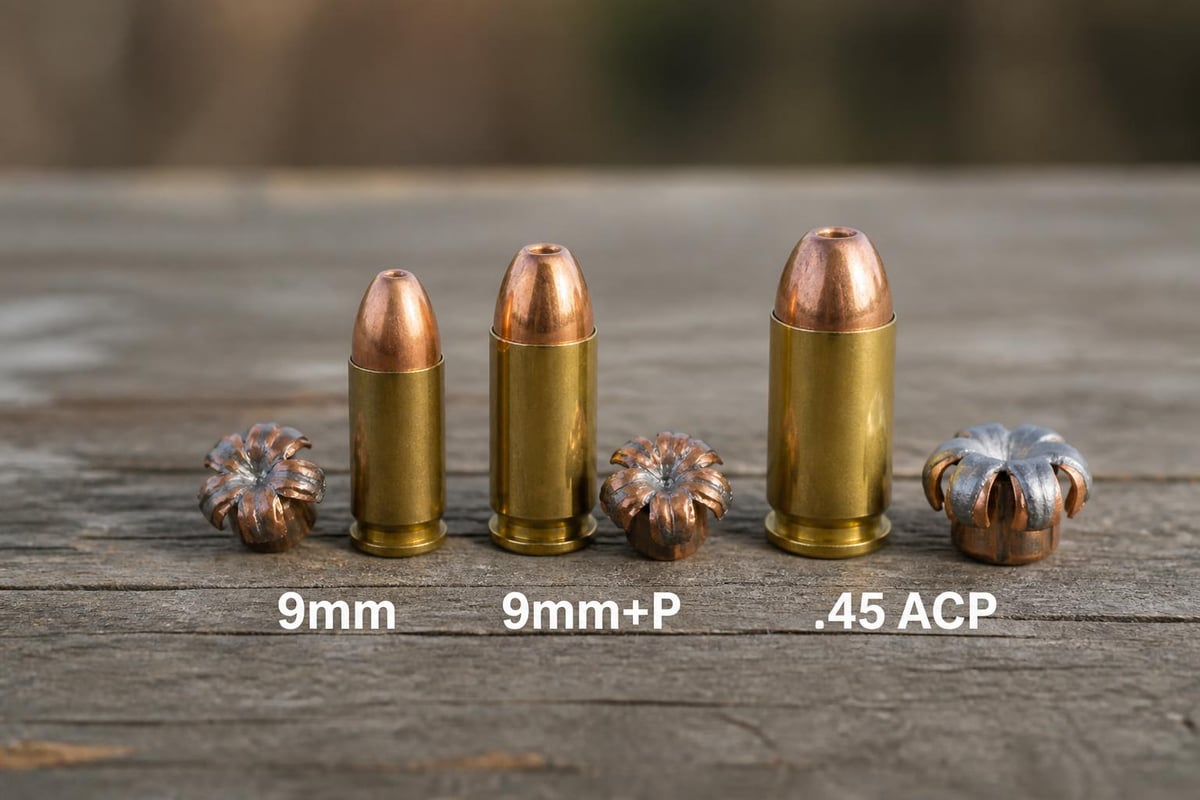
Key ballistic differences include:
- 9mm muzzle energy: 300-400 foot-pounds
- .45 ACP muzzle energy: 350-500 foot-pounds
- 9mm penetration depth: 12-18 inches in ballistic gelatin
- .45 ACP penetration depth: 14-20 inches in ballistic gelatin
- Wound cavity diameter varies based on bullet expansion
According to detailed ballistic analysis, modern hollow-point ammunition has narrowed the performance gap significantly. Premium defensive loads in both calibers consistently meet FBI penetration standards while achieving reliable expansion.
| Specification | 9mm Luger | .45 ACP |
|---|---|---|
| Bullet Weight | 115-147 gr | 185-230 gr |
| Muzzle Velocity | 1,100-1,300 fps | 800-1,000 fps |
| Muzzle Energy | 300-400 ft-lbs | 350-500 ft-lbs |
| Average Recoil | 4-5 ft-lbs | 7-8 ft-lbs |
Modern Ammunition Technology
The evolution of defensive ammunition technology has fundamentally changed the 9mm vs 45 acp for self defense discussion. Today's bonded hollow-points and barrier-blind projectiles perform dramatically better than the ball ammunition that fueled earlier debates.
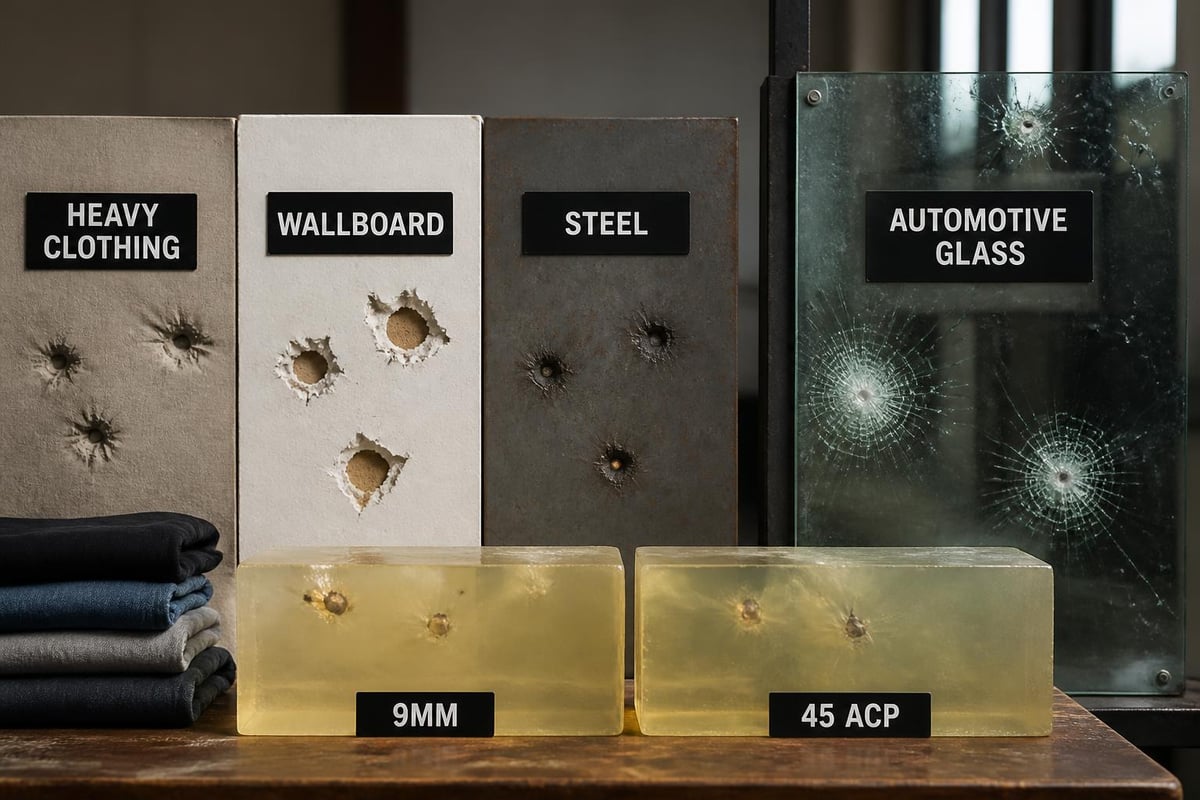
Federal HST, Speer Gold Dot, and Hornady Critical Duty represent the current gold standard in defensive ammunition. These loads demonstrate consistent expansion and penetration regardless of intermediate barriers like heavy clothing, wallboard, or automotive glass. The performance gap between calibers has narrowed to the point where shot placement and shooter proficiency matter more than the specific cartridge selected.
Capacity and Reload Considerations
Magazine capacity represents one of the most significant practical differences when comparing 9mm vs 45 acp for self defense. The smaller 9mm cartridge allows manufacturers to design higher-capacity magazines within the same grip dimensions.
Magazine Capacity Analysis
A full-size 9mm handgun typically holds 15-17 rounds in the magazine, with some models reaching 19-20 rounds. Compact 9mm pistols generally accommodate 12-15 rounds. By contrast, a full-size .45 ACP pistol usually holds 8-10 rounds, while compact versions often limit capacity to 6-8 rounds.
Capacity advantages breakdown:
- Full-size 9mm: 15-20 rounds standard capacity
- Compact 9mm: 12-15 rounds standard capacity
- Full-size .45 ACP: 8-10 rounds standard capacity
- Compact .45 ACP: 6-8 rounds standard capacity
This capacity difference becomes particularly relevant in defensive scenarios where multiple threats may be present or shots may be required on a single determined attacker. Statistical analysis of defensive encounters suggests that most incidents involve 2-4 rounds fired, making either caliber sufficient for typical scenarios.
However, the additional capacity provides a margin of error for missed shots under stress. As noted in comprehensive caliber comparisons, the ability to continue engaging without reloading offers a psychological and tactical advantage.
Recoil Management and Controllability
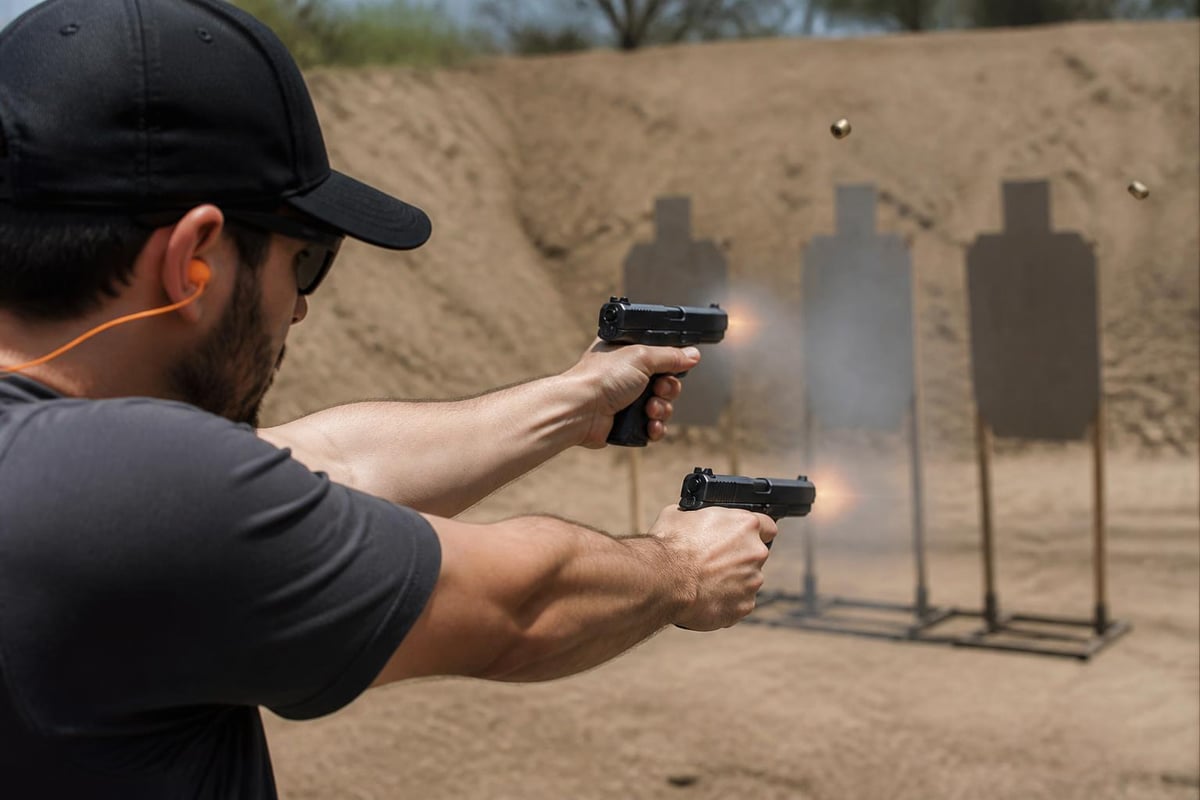
Recoil characteristics directly impact follow-up shot speed and accuracy, making this factor crucial when evaluating 9mm vs 45 acp for self defense. The .45 ACP generates approximately 60-80% more felt recoil than the 9mm in comparable pistol platforms.
Shooter Performance Factors
Smaller-statured shooters, those with hand strength limitations, or individuals new to defensive handguns often find the 9mm more manageable. The reduced recoil allows faster target reacquisition and more accurate follow-up shots, which can prove decisive in high-stress encounters.
The .45 ACP's heavier recoil isn't necessarily prohibitive for experienced shooters with proper grip technique. Many shooters describe the .45's recoil as more of a "push" compared to the 9mm's "snap," though this perception varies based on individual pistol design and shooter physiology.
Training frequency influences recoil management capabilities significantly. Shooters who practice regularly can adapt to the .45 ACP's recoil characteristics, while those who train infrequently may struggle to maintain proficiency with the heavier-recoiling cartridge.
Cost and Training Efficiency
Ammunition cost directly impacts training volume, which represents the single most important factor in defensive shooting proficiency. When examining 9mm vs 45 acp for self defense from a training perspective, the price difference becomes substantial over time.
Economic Training Considerations
Current market conditions show 9mm ammunition typically costs 30-40% less than .45 ACP for comparable quality levels. This price differential means shooters can afford more range sessions or fire more rounds per session with 9mm, accelerating skill development.
| Factor | 9mm | .45 ACP |
|---|---|---|
| Target ammunition (per 50) | $15-20 | $25-35 |
| Defensive ammunition (per 20) | $18-25 | $28-40 |
| Annual training cost (1,000 rounds) | $300-400 | $500-700 |
For those considering a comprehensive training program, the cost savings with 9mm allow investment in quality instruction or additional practice ammunition. As explained in detailed cost analysis, the cumulative savings over several years of regular practice can exceed the initial cost of the firearm itself.
Platform Selection and Availability
The specific handgun platform influences the practical considerations when choosing between 9mm vs 45 acp for self defense. Firearm manufacturers offer significantly more 9mm models than .45 ACP options, providing greater variety in size, features, and price points.
Modern Pistol Design Trends
Contemporary 9mm pistols benefit from decades of refinement focused on maximizing capacity within compact dimensions. Striker-fired designs from major manufacturers have optimized the 9mm cartridge's dimensions to create slim, easy-to-conceal packages with 15+ round capacities.
The .45 ACP's larger cartridge dimensions necessitate wider grips and larger frames, which some shooters find less comfortable for extended carry or challenging to conceal effectively. However, modern .45 ACP designs have made significant strides in reducing overall dimensions while maintaining acceptable capacity.
Platform considerations include:
- Grip circumference and hand fit
- Overall weight when fully loaded
- Concealability for daily carry
- Holster compatibility and options
- Aftermarket support and accessories
Whether you're selecting a primary defensive handgun or adding to an existing collection, RCS Outdoors maintains an extensive inventory of both 9mm and .45 ACP pistols from leading manufacturers, ensuring you'll find the right platform for your needs.
Real-World Performance Data
FBI testing protocols and law enforcement agency research provide valuable empirical data regarding 9mm vs 45 acp for self defense effectiveness. The FBI's 2014 decision to transition from .40 S&W back to 9mm reflected extensive ballistic testing and analysis of actual shooting incidents.
Law Enforcement Adoption Trends
The overwhelming majority of American law enforcement agencies now issue 9mm handguns as their standard service weapon. This trend reflects the caliber's combination of adequate stopping power, higher capacity, reduced recoil, and lower training costs.
According to research compiled in historical context analysis, documented defensive shooting incidents show no statistically significant difference in one-shot stop rates between quality 9mm and .45 ACP ammunition. The determining factors consistently prove to be shot placement and penetration depth rather than caliber selection.
Medical examiner reports and wound ballistics research indicate that both calibers, when loaded with modern hollow-point ammunition, create similar wound channels and achieve comparable physiological effects. The .45 ACP's larger diameter offers minimal practical advantage when bullets expand to similar diameters upon impact.
Practical Carry Considerations
Daily concealed carry introduces additional factors beyond pure ballistic performance when evaluating 9mm vs 45 acp for self defense. The weight difference between a loaded 9mm and .45 ACP pistol of similar size ranges from 4-8 ounces, which becomes noticeable during extended carry periods.
Comfort and Compliance Factors
Defensive firearms only provide protection when actually carried. A lighter, more comfortable 9mm pistol that gets carried daily provides superior protection compared to a heavier .45 ACP that remains in the safe due to carry discomfort.
The 9mm's reduced dimensions in comparable capacity platforms often facilitate more discreet concealment. This advantage proves particularly valuable for individuals with smaller builds or those who require deep concealment in professional environments.
Seasonal variations affect carry decisions significantly. Summer clothing offers less concealment opportunity, making the slimmer 9mm platforms more practical. Winter garments accommodate larger .45 ACP pistols more easily, though the added weight remains a consideration.
Daily carry factors:
- All-day comfort during normal activities
- Clothing compatibility across seasons
- Print visibility in various positions
- Weight distribution and holster design
- Accessibility for rapid presentation
As detailed in comprehensive comparison resources, successful defensive carry depends on consistent daily practice with your chosen platform, regardless of caliber selection.
Training and Skill Development
Defensive shooting proficiency requires regular practice and quality training. The relationship between ammunition cost and training frequency makes 9mm vs 45 acp for self defense selection partially a training economics decision.
Practice Volume Impact
Shooters who train with 9mm can typically afford to fire 30-50% more rounds per training session compared to .45 ACP shooters working within the same budget. This increased volume accelerates skill development in fundamental areas like trigger control, sight alignment, and recoil management.
For new shooters building defensive skills, the 9mm's milder recoil prevents development of anticipation and flinching habits. These negative training adaptations prove difficult to correct and significantly degrade accuracy under stress.
Advanced training courses and defensive shooting schools overwhelmingly recommend 9mm for students. The reduced fatigue during high-round-count courses allows students to focus on technique rather than managing recoil-induced discomfort.
| Training Aspect | 9mm Advantage | .45 ACP Advantage |
|---|---|---|
| Ammunition cost | Significant savings | Higher expense |
| Recoil management | Easier for new shooters | Manageable for experienced shooters |
| Follow-up speed | Faster split times | Acceptable with practice |
| Training fatigue | Less hand/wrist strain | More physical demand |
Medical and Physiological Effects
Terminal ballistics research examining actual defensive shooting outcomes provides insight into the physiological effects of 9mm vs 45 acp for self defense. Both calibers demonstrate the capability to rapidly incapacitate threats when quality ammunition achieves proper shot placement.
Wound Channel Analysis
The temporary and permanent wound cavities created by modern defensive ammunition in both calibers prove adequate for defensive purposes. The .45 ACP's larger permanent crush cavity offers marginal advantage, while the 9mm's higher velocity creates slightly more temporary cavitation in elastic tissue.
Penetration depth matters more than caliber for achieving reliable incapacitation. Both 9mm and .45 ACP rounds must penetrate 12-18 inches to consistently reach vital organs and major blood vessels regardless of impact angle or intermediate barriers.
Bullet expansion reliability influences effectiveness more significantly than initial caliber. Premium bonded hollow-points in 9mm routinely expand to .60-.70 inches, while .45 ACP defensive loads expand to .75-.90 inches. This expanded diameter difference proves less significant than consistent expansion performance.
Personal Assessment Framework
Selecting between 9mm vs 45 acp for self defense ultimately requires honest evaluation of individual circumstances, physical capabilities, and intended use. No single caliber proves universally superior across all criteria and user profiles.
Critical self-assessment questions:
- Can you consistently achieve accurate shot placement with both calibers under stress?
- Does the .45 ACP's recoil significantly slow your follow-up shots?
- Will higher ammunition costs reduce your training frequency?
- Does the capacity difference influence your confidence level?
- Can you comfortably carry the platform size required for your chosen caliber?
Physical factors including hand size, grip strength, and body type influence platform compatibility. Shooters with smaller hands often struggle to achieve proper grip on double-stack .45 ACP pistols, compromising control and accuracy.
Medical conditions affecting hand strength, arthritis, or previous injuries may make the 9mm's reduced recoil essential for maintaining shooting proficiency. Honest evaluation of physical limitations prevents selecting equipment that looks effective on paper but proves difficult to use effectively.
As noted in comparative analysis resources, the best defensive caliber is the one you can shoot accurately and carry consistently.
Situational and Environmental Context
The intended defensive scenarios influence optimal caliber selection when comparing 9mm vs 45 acp for self defense. Home defense situations differ from concealed carry requirements, potentially justifying ownership of both calibers for different applications.
Home Defense Applications
Home defense scenarios often involve longer sight distances, potential barriers like interior walls, and the advantage of knowing your environment. The .45 ACP's heavier bullet maintains energy through barriers more consistently, though modern barrier-blind 9mm loads have largely eliminated this advantage.
Higher capacity proves valuable in home defense situations where multiple intruders represent a potential threat. The ability to engage multiple targets without reloading provides tactical flexibility and psychological confidence.
Overpenetration concerns affect both calibers similarly when using quality defensive ammunition. Proper load selection matters more than caliber choice for minimizing risk to family members in adjacent rooms.
Vehicle Defense Considerations
Defensive scenarios involving vehicles present unique challenges including automotive glass, sheet metal, and angled impacts. Both 9mm and .45 ACP defensive loads demonstrate adequate performance through automotive barriers when using barrier-blind designs.
The compact dimensions of 9mm platforms prove advantageous in vehicle environments where space constraints complicate weapon presentation. The ability to manipulate a defensive firearm within a vehicle's confined space often matters more than marginal ballistic differences.
Both 9mm and .45 ACP deliver reliable defensive performance when paired with quality ammunition and adequate training. Your selection should prioritize the caliber you shoot most accurately and carry most consistently.
When you're ready to purchase your defensive handgun, ammunition, or training supplies, RCS Outdoors offers an extensive selection of firearms and accessories from trusted manufacturers. Whether you choose 9mm or .45 ACP, their knowledgeable team can help you find the right platform and support your ongoing training needs with quality ammunition at competitive prices.


