

Sporting Clays vs Trap vs Skeet: Complete Guide 2026
Clay target shooting offers exceptional opportunities for shooters to refine their skills, enjoy competitive recreation, and prepare for hunting season. Understanding the distinctions between sporting clays vs trap vs skeet helps new and experienced shooters select the discipline that best matches their goals and preferences. Each sport presents unique challenges, follows different rules, and develops specific shooting skills that translate to various real-world applications.
Understanding the Three Major Clay Shooting Disciplines
Clay target sports have evolved from simple beginnings into sophisticated competitive disciplines. Each variation was designed to simulate different aspects of bird hunting and wing shooting.
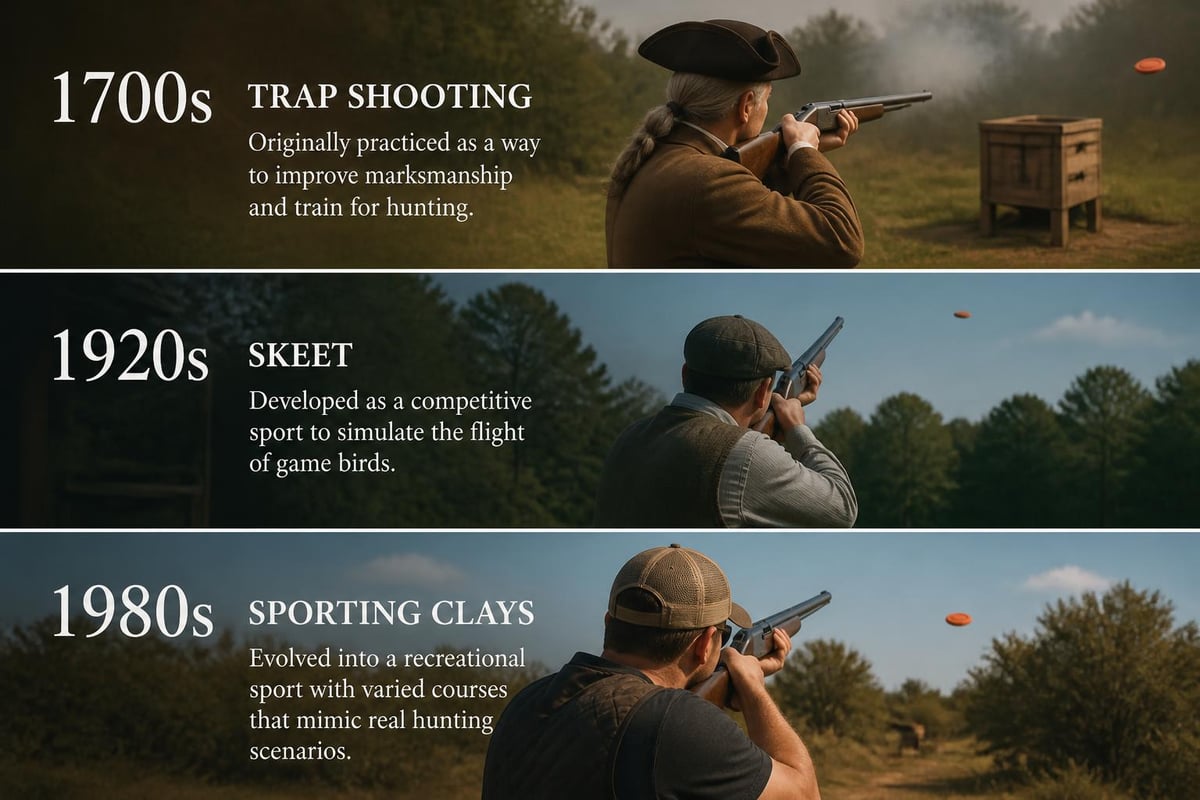
Trap shooting emerged first in the late 18th century in England, originally using live pigeons before transitioning to clay targets. Skeet shooting was developed in the 1920s in the United States as "shooting around the clock," providing shooters with a more comprehensive range of angles. Sporting clays arrived later, originating in England during the 1980s as the most realistic simulation of field hunting scenarios.
Historical Development and Purpose
The progression from trap to skeet to sporting clays reflects an increasing desire for variety and hunting realism. Trap shooting was initially created to practice shooting departing game birds, while skeet was designed to provide incoming and crossing shots that trap couldn't offer.
Sporting clays took the concept further by incorporating terrain, multiple target types, and varied presentations that mirror actual hunting situations. This evolution demonstrates how the shooting community continuously refined these sports to better serve both competitive shooters and hunters preparing for field conditions.
Trap Shooting Fundamentals and Techniques
Trap shooting remains the oldest and most straightforward of the three disciplines. Shooters stand at one of five positions arranged in a straight line, 16 yards behind a single trap house.
The trap machine oscillates unpredictably, throwing targets away from shooters at varying horizontal angles. Targets travel at approximately 41 mph and can be launched up to 15 degrees left or right of center. Shooters don't know the exact direction until the target appears.
Trap Shooting Format and Scoring
A standard trap round consists of 25 targets, with five shots taken from each of the five stations. Shooters rotate positions after completing five targets, moving systematically from station one through station five.
Key trap shooting characteristics:
- Targets always move away from the shooter
- Limited horizontal angle variation
- Consistent target distance and speed
- Straightforward scoring (hit or miss)
- Excellent for developing follow-through
Singles trap represents the most common format, though handicap trap and doubles trap offer additional challenges. In handicap trap, accomplished shooters stand farther back (up to 27 yards), while doubles trap launches two targets simultaneously.
Skeet Shooting Layout and Challenges
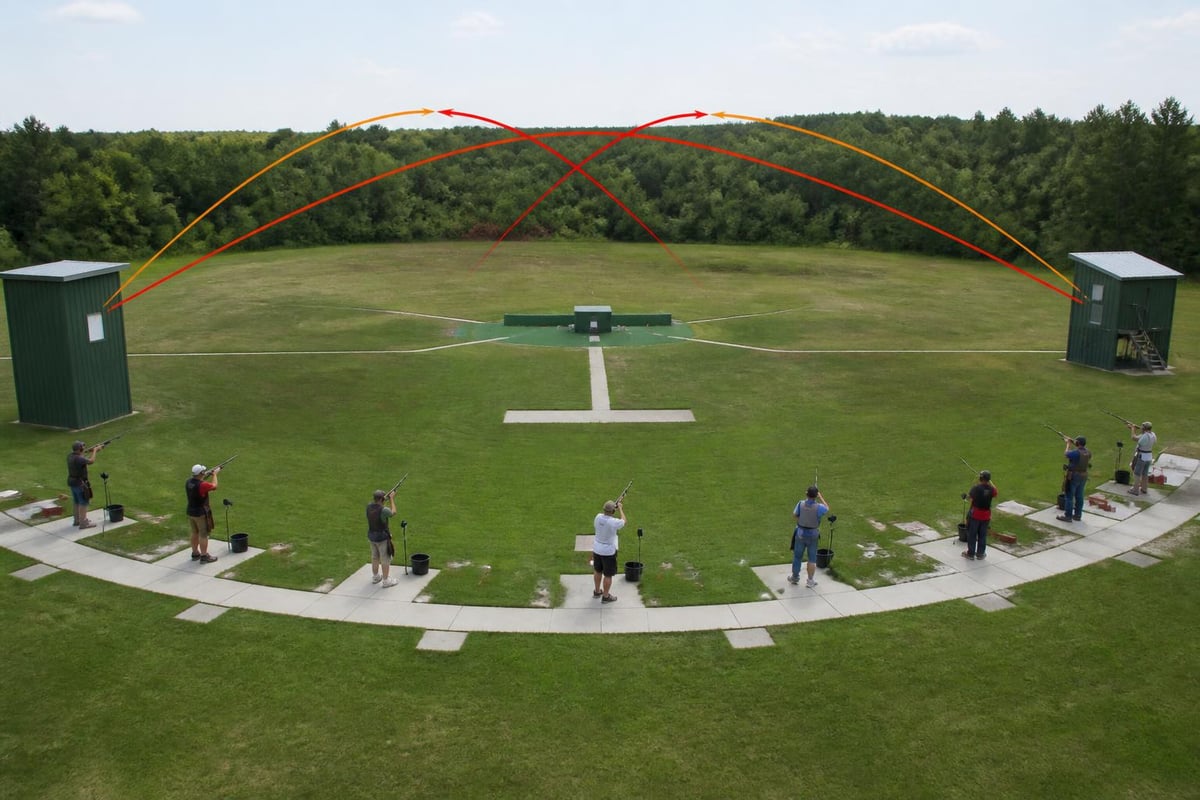
Skeet shooting provides the most structured and predictable format among sporting clays vs trap vs skeet disciplines. The course features eight shooting stations arranged in a semicircle, with two trap houses positioned at opposite ends.
The high house stands 10 feet tall on the left side, while the low house sits just 3.5 feet high on the right. Targets cross at a fixed point 15 feet above the center of the field, creating consistent angles that shooters can learn and master.
Station-by-Station Breakdown
Each station presents unique target angles and timing requirements. Stations one and seven, positioned directly in front of the trap houses, offer the most challenging shots as targets appear extremely fast and require precise timing.
| Station | Target Type | Difficulty Level | Key Challenge |
|---|---|---|---|
| 1 | High/Low House | High | Extreme speed at close range |
| 2 | High/Low House | Medium | Fast crossing shots |
| 3 | High/Low House | Medium | Timing the intersection |
| 4 | High/Low House | High | Overhead crossing shots |
| 5 | High/Low House | Medium | Reverse angles from stations 1-3 |
| 6 | High/Low House | Medium | Fast outgoing targets |
| 7 | High/Low House | High | Close, fast targets |
| 8 | High/Low House | Low | Straight incoming shots |
A complete skeet round requires 25 shots: one high house and one low house target from stations one through seven, plus four targets from station eight (two high, two low), and one optional shot for any missed target.
Doubles and Timing Requirements
Stations one, two, six, and seven also feature doubles, where both targets are thrown simultaneously. This tests a shooter's ability to quickly transition between targets while maintaining proper form and follow-through.
Understanding the differences between skeet and trap helps shooters appreciate how each discipline develops different aspects of shooting proficiency.
Sporting Clays Course Design and Variety
Sporting clays represents the most dynamic and unpredictable discipline when comparing sporting clays vs trap vs skeet. Often called "golf with a shotgun," sporting clays courses utilize natural terrain and vegetation to create hunting simulations.
Courses typically feature 10 to 15 stations, each presenting different target combinations. Unlike the standardized layouts of trap and skeet, sporting clays stations can replicate specific hunting scenarios such as flushing quail, passing doves, or springing rabbits.
Target Presentations and Simulations
Target variety distinguishes sporting clays from its more structured counterparts. Standard, midi, mini, battue, and rabbit targets all behave differently in flight, requiring shooters to adapt their technique constantly.
Common sporting clays presentations:
- Chandelle: Targets climb steeply, slowing at the apex
- Rabbit: Ground-rolling targets that bounce unpredictably
- Teal: Targets launched straight up, then falling
- Crossing pairs: Two targets from different directions
- Following pairs: Two targets from the same direction
- Report pairs: Second target launches at the sound of the first shot
Each station may present singles, simultaneous pairs, or report pairs, with shooters typically engaging 8 to 10 targets per station for a complete 100-target course.
Equipment Considerations
While a basic pump-action or semi-automatic shotgun works for any clay sport, competitive sporting clays often demands specialized equipment. Over-under shotguns with interchangeable chokes allow shooters to optimize their pattern for each station's specific challenges.
Serious sporting clays competitors frequently adjust choke constrictions between stations, using cylinder or improved cylinder for close, fast targets and modified or full chokes for distant presentations.
Shotgun Setup and Choke Selection
Equipment requirements vary significantly across the three disciplines. Understanding these differences helps shooters optimize their performance and enjoyment.
Trap Shotgun Specifications
Trap shooters prefer longer barrels (30 to 34 inches) that provide smoother swings and extended sight radius. Since all targets move away from the shooter, trap guns typically feature higher ribs and stocks that promote shooting above the target.
Choke selection for trap leans toward tighter constrictions. Modified, improved modified, or full chokes create dense patterns at the 35 to 45-yard ranges where trap targets are typically broken.
Skeet Shotgun Requirements
Skeet shooting demands fast target acquisition and minimal lead at close range. Barrels typically measure 26 to 30 inches, offering quick handling for fast crossing shots. Skeet chokes (or cylinder bore) provide wide, open patterns perfect for 20 to 25-yard shots.
Stock dimensions differ from trap guns, with flatter ribs promoting a more level sight picture suitable for skeet's varied target angles.
Sporting Clays Versatility
Sporting clays shotguns prioritize adaptability. Most competitors choose 12-gauge over-under shotguns with 28 to 32-inch barrels and multiple choke tubes. This setup allows adjustment for each station's unique requirements.
| Discipline | Barrel Length | Common Chokes | Stock Configuration |
|---|---|---|---|
| Trap | 30-34 inches | Modified to Full | High comb, more drop |
| Skeet | 26-30 inches | Skeet/Cylinder | Flatter rib, less drop |
| Sporting Clays | 28-32 inches | Variable (IC to Full) | Adjustable or neutral |
Gauge selection also varies. While 12-gauge dominates all three sports, competitive skeet includes dedicated divisions for 20, 28, and .410 gauge shotguns.
Skill Development and Learning Curves
Each discipline in the sporting clays vs trap vs skeet comparison develops different shooting competencies. New shooters often wonder which sport offers the best starting point.
Trap shooting provides the gentlest introduction. Targets always move in the same general direction, allowing beginners to focus on fundamental mounting, swing, and follow-through without excessive complexity.
Progression Through the Disciplines
Many shooting instructors recommend starting with trap to build basic skills, then advancing to skeet to develop timing and lead calculation. Sporting clays becomes more approachable once shooters have mastered the foundational techniques from trap and skeet.
Skill emphasis by discipline:
- Trap: Follow-through, sustained lead, consistency
- Skeet: Target acquisition speed, precise timing, swing mechanics
- Sporting Clays: Adaptability, target reading, quick decision-making
Skeet's predictable target presentations allow shooters to practice specific angles repeatedly until muscle memory develops. The variability in sporting clays prevents this kind of repetitive practice, making it more challenging for developing consistent technique.
Competition Formats and Scoring Systems
Understanding competitive structures helps shooters set goals and track improvement across sporting clays vs trap vs skeet disciplines.
Trap Competition Levels
Trap competitions use straightforward scoring: one point per broken target. Leagues and tournaments classify shooters by average score, with AA shooters breaking 97% or more targets consistently.
Major trap competitions include the Grand American, which attracts thousands of shooters annually for multiple events spanning several days. Singles, handicap, and doubles events each crown separate champions.
Skeet Tournament Structure
Skeet competitions also award one point per target, with 25 targets per round. Perfect scores (25 straight) occur regularly among advanced shooters, necessitating shoot-offs to determine winners.
The National Skeet Shooting Association (NSSA) organizes competitions across five gauge divisions, with competitors potentially shooting all five gauges during major tournaments to compete for high-overall-average honors.
Sporting Clays Classification
Sporting clays uses a similar one-point-per-target system, but course difficulty varies significantly. A challenging 100-target course might see winning scores around 85, while easier layouts could require perfect or near-perfect scores.
The National Sporting Clays Association (NSCA) classifies shooters into classes (E through Master) based on recent performance averages, ensuring competitive balance across skill levels.
Hunting Applications and Transferable Skills
Beyond competition, clay sports serve as excellent training for actual hunting situations. Each discipline develops skills that translate differently to field scenarios.
Trap shooting builds proficiency for pass shooting at waterfowl and doves, where targets typically move away or across at moderate angles. The sustained-lead technique learned in trap applies directly to these hunting situations.
Upland Game and Skeet Training
Skeet's varied angles and close-range, fast targets mirror upland bird hunting more closely. Flushing quail, pheasants, and grouse present similar challenges: sudden appearances, rapid target acquisition requirements, and shots at various angles.
Hunters preparing for upland seasons find tremendous value in regular skeet practice. The discipline's emphasis on quick mounting and instinctive shooting translates directly to field success.
Sporting Clays as Comprehensive Preparation
Sporting clays offers the most complete hunting simulation. Well-designed courses replicate specific game bird behaviors, allowing hunters to practice scenarios they'll encounter in the field.
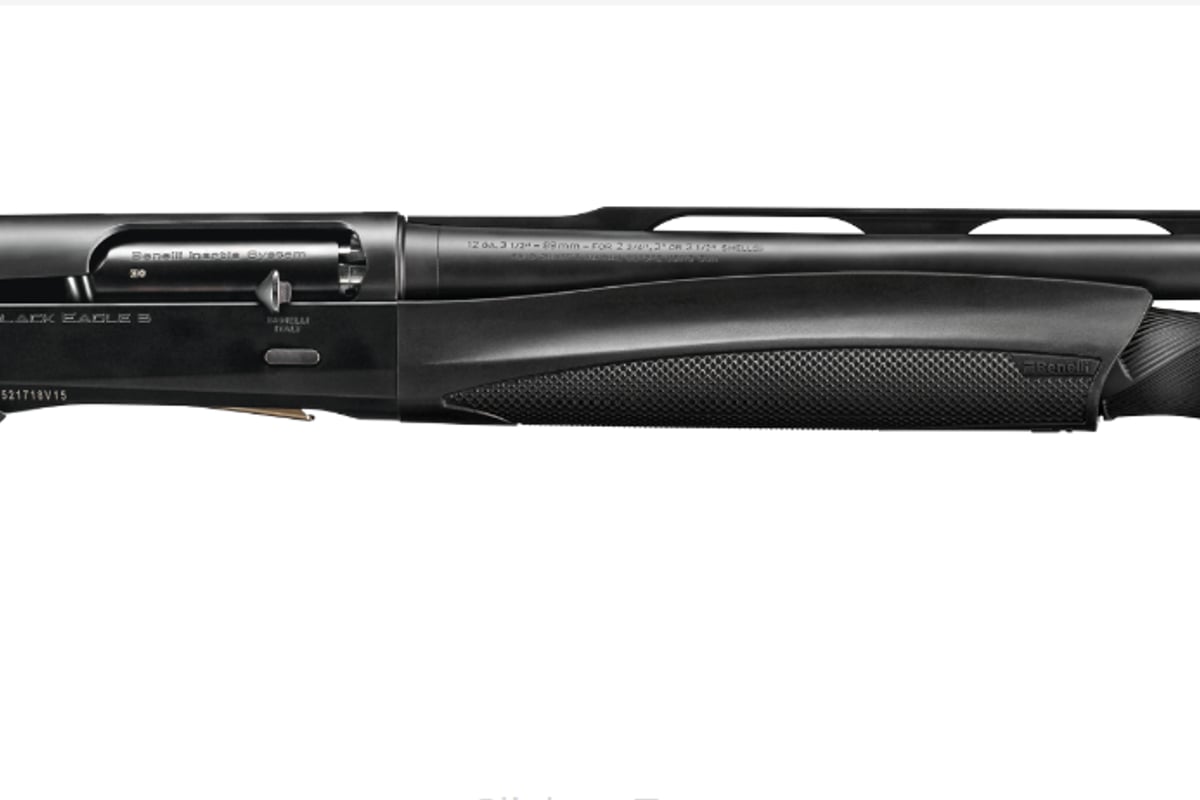
For hunters looking to sharpen their skills before the season, sporting clays provides invaluable experience. The Upland Escape Giveaway celebrates this connection between clay sports and upland hunting, offering participants a chance to experience world-class wingshooting at Heartland Lodge combined with a premium Benelli shotgun designed specifically for upland pursuits.
Transitioning from Clays to Game Birds
While clay targets travel faster than most game birds, the target acquisition, swing mechanics, and follow-through remain identical. Successful clay shooters typically become proficient hunters with minimal adjustment.
The primary difference involves environmental factors: wind affects live birds differently than clays, and hunters must account for vegetation, terrain, and unpredictable flushing patterns.
Cost Considerations and Accessibility
Financial factors influence which discipline shooters pursue regularly. Understanding the cost structure helps with budgeting and planning.
Facility Availability
Trap fields are most common, found at many gun clubs and public ranges. The simple layout and single trap machine make trap the most accessible discipline for new facilities.
Skeet fields require more investment: two trap houses, specific positioning, and maintenance of both machines. Consequently, skeet facilities are less common than trap but still widely available.
Sporting clays courses demand the most significant investment and land area. Establishing multiple stations with varied terrain, different trap machines, and proper target presentations requires substantial resources.
Per-Round Costs
Typical pricing structures reflect these facility differences:
- Trap: $6-$10 per round (25 targets)
- Skeet: $7-$12 per round (25 targets)
- Sporting Clays: $30-$50 per round (50-100 targets)
Ammunition costs add significantly to the total expense. A 100-target sporting clays session requires four boxes of shells, potentially costing $30-$80 depending on ammunition choice.
Equipment Investment
Entry-level shotguns suitable for any discipline start around $400-$600. However, specialized competition guns range from $2,000 to $10,000 or more.
Budget-conscious shooters can compete effectively with quality used shotguns and factory ammunition. Success depends more on practice volume and technique than equipment cost, especially for recreational shooters.
Physical and Mental Demands
Each discipline in sporting clays vs trap vs skeet comparisons presents unique physical and mental challenges that affect shooter performance and enjoyment.
Physical Requirements
Trap shooting requires the least physical exertion. Shooters stand in fixed positions with minimal walking between stations. This makes trap ideal for older shooters or those with mobility limitations.
Skeet demands more movement as shooters rotate through eight stations, though the distances remain manageable. The quick target presentations require faster reflexes and mounting speed.
Sporting clays involves the most physical activity. Walking between 10-15 stations across varied terrain, often carrying 100 or more shells, provides a moderate cardiovascular workout. Uneven ground and elevation changes add complexity.
Mental Aspects and Focus
All three sports demand intense concentration, but the mental challenges differ. Trap's repetitive nature tests consistency and the ability to maintain focus through identical presentations.
Skeet requires memorization of specific hold points and lead pictures for each station, testing a shooter's ability to execute learned techniques under pressure.
Sporting clays challenges problem-solving skills and adaptability. Shooters must quickly analyze new presentations, select appropriate technique, and execute without the benefit of repeated practice on identical targets.
Mental skills developed:
- Trap: Consistency, routine building, pressure management
- Skeet: Memorization, precise execution, rhythm maintenance
- Sporting Clays: Adaptability, quick decision-making, confidence building
Competitive shooters in all disciplines develop mental resilience through regular practice and tournament participation. The psychological aspects often separate good shooters from great ones.
Safety Protocols Across Disciplines
Safety remains paramount in all shooting sports. While basic firearms safety applies universally, each discipline has specific protocols shooters must follow.
Range Commands and Procedures
Trap ranges use standardized voice commands. Shooters call for targets individually, maintaining clear communication with nearby competitors and range officials.
Skeet fields implement similar protocols, with shooters announcing "Pull" or using mechanical trigger systems to launch targets. The presence of two trap houses requires heightened awareness of crossing flight paths.
Sporting clays stations vary in layout and target presentation, necessitating careful attention to range briefings. Some stations feature elevated platforms, while others require shooting near walking paths, demanding strict muzzle discipline.
Equipment Safety Checks
Before beginning any round, shooters should verify their shotgun functions properly, ammunition is appropriate for the discipline, and hearing and eye protection is in place.
Essential safety equipment:
- Shooting glasses (ANSI Z87.1 rated or higher)
- Hearing protection (foam plugs, earmuffs, or electronic)
- Appropriate footwear for terrain
- Shell pouch or vest to organize ammunition
- Gun case for transport
Many facilities require action flags or chamber flags when guns are not in use, providing visual confirmation that firearms are unloaded and safe.
Club Culture and Social Aspects
Beyond technical differences, sporting clays vs trap vs skeet disciplines cultivate distinct social environments and club cultures.
Trap leagues often meet weekly, fostering tight-knit communities where shooters compete against personal averages as much as opponents. The format encourages social interaction between rounds while maintaining focus during shooting.
Team Dynamics
Skeet shooting frequently involves squad shooting, where five participants shoot together, rotating through stations as a group. This creates natural camaraderie and shared experiences.
Competitive skeet teams represent clubs at regional and national tournaments, building strong bonds through travel and shared goals. The predictable format allows teams to practice together effectively.
Sporting clays tends toward more individualized participation, though many clubs organize leagues and group outings. The walking nature and course layout encourage conversation between stations, creating a relaxed, social atmosphere.
Family Participation
All three disciplines welcome families and shooters of all ages. Youth programs exist for trap, skeet, and sporting clays, often providing subsidized fees and coaching.
Trap's simplicity makes it particularly accessible for young shooters learning fundamentals. Skeet and sporting clays offer youth-specific programs through organizations like the Scholastic Clay Target Program (SCTP).
Selecting Your Best Fit
Choosing between sporting clays vs trap vs skeet depends on individual goals, available facilities, budget, and personal preferences. No single discipline is objectively "best."
New shooters should consider trying all three before committing to regular practice in one discipline. Many ranges offer sampler packages or introductory sessions that include instruction and equipment rental.
Matching Discipline to Goals
Choose trap if you:
- Prefer structured, repetitive practice
- Want to develop consistent technique
- Have limited time for travel to ranges
- Enjoy league competition with weekly attendance
- Focus on departing target skills for waterfowl hunting
Choose skeet if you:
- Enjoy fast-paced, close-range shooting
- Want to master specific angles through repetition
- Prepare primarily for upland bird hunting
- Appreciate the social squad shooting format
- Seek standardized competition experiences
Choose sporting clays if you:
- Value variety and unpredictability
- Want comprehensive hunting simulation
- Enjoy problem-solving and adaptation
- Don't mind higher per-round costs
- Have access to quality sporting clays facilities
Understanding these distinctions helps shooters invest their practice time and resources most effectively.
Combining Disciplines
Many accomplished shotgunners practice multiple disciplines, recognizing that each develops complementary skills. Trap builds follow-through, skeet develops quick acquisition, and sporting clays combines these abilities with adaptability.
Cross-training prevents plateaus and maintains interest through variety. Competition shooters often find that skills developed in one discipline transfer beneficially to others, creating well-rounded shooting proficiency.
Understanding the distinctions between sporting clays vs trap vs skeet empowers shooters to select the discipline that best matches their goals, whether competitive shooting, hunting preparation, or recreational enjoyment. Each sport offers unique challenges and rewards that develop valuable shotgunning skills. When you're ready to pursue your clay shooting interests with the right equipment, RCS Outdoors provides the firearms, ammunition, and accessories you need to excel in any discipline, backed by expertise and competitive pricing that support your shooting journey.


