

AR-15 vs AR-10: Platform Comparison Guide (2026)
The AR-15 vs AR-10 debate represents one of the most fundamental decisions facing modern rifle enthusiasts, hunters, and competitive shooters. While both platforms share a common design lineage and distinctive appearance, the differences between these two rifles extend far beyond superficial similarities. Understanding the caliber variations, performance characteristics, parts compatibility, and practical applications helps shooters select the right platform for their specific needs, whether that involves home defense, precision shooting, or hunting big game across diverse terrain.
Historical Development and Design Philosophy
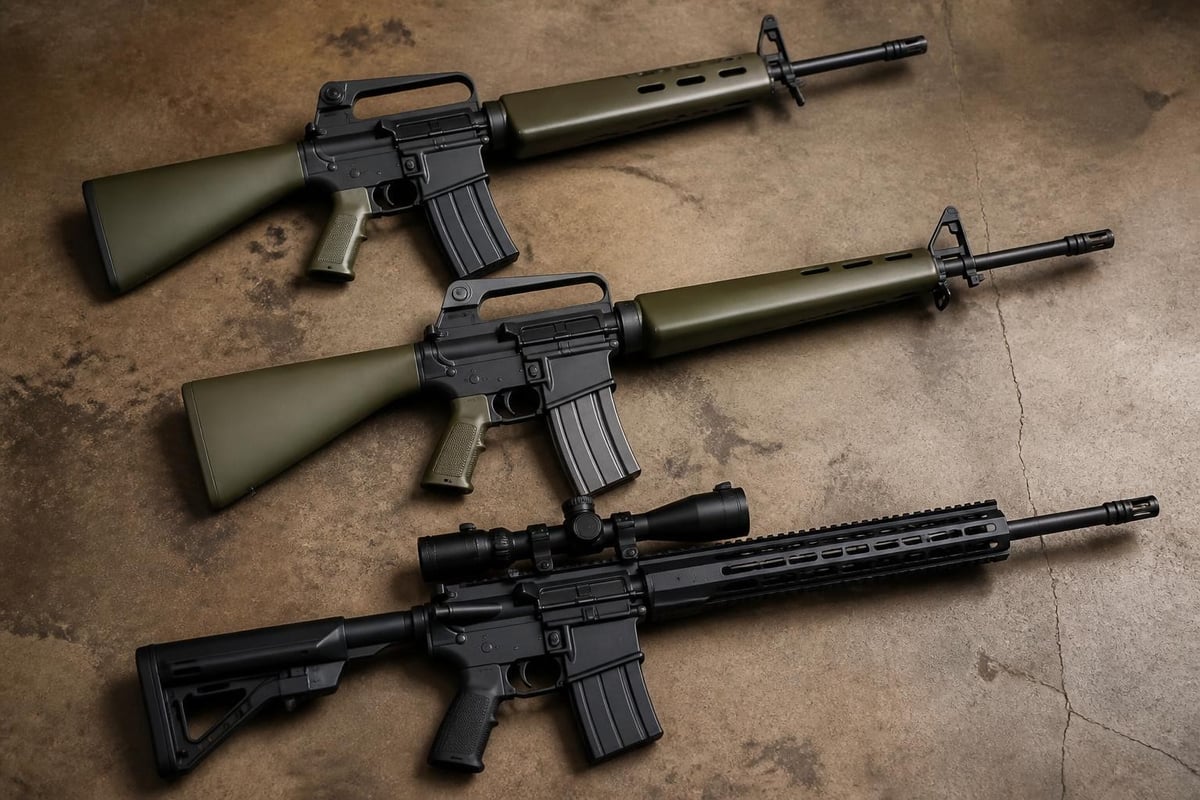
The AR-10 actually predates its smaller counterpart by several years. Eugene Stoner developed the original AR-10 in the 1950s as a battle rifle chambered in 7.62×51mm NATO. This full-power rifle cartridge offered significant stopping power and range, but military requirements evolved toward lighter ammunition that allowed soldiers to carry more rounds.
This shift in military doctrine led to the development of the AR-15 platform in the late 1950s and early 1960s. Scaled down to accommodate the .223 Remington/5.56×45mm NATO cartridge, the AR-15 became lighter, more controllable, and better suited for the modern battlefield concept of volume of fire over individual shot power.
Modern Platform Evolution
Both platforms have undergone substantial evolution since their military origins. Today's civilian AR-15 and AR-10 rifles incorporate decades of refinement, featuring improved materials, enhanced ergonomics, and modular designs that allow extensive customization. The fundamental differences between these platforms stem primarily from their chambering requirements and the engineering constraints those cartridges impose.
The AR-15 platform has become the most popular rifle system in America, with millions of units in civilian hands. The AR-10, while less common, has carved out a dedicated following among long-range shooters and hunters who require the additional power of the .308 Winchester cartridge.
Caliber and Ballistic Performance Comparison
The most significant difference in the AR-15 vs AR-10 comparison centers on caliber selection. The AR-15 typically chambers .223 Remington or 5.56×45mm NATO, while the AR-10 handles .308 Winchester or 7.62×51mm NATO. This caliber difference creates cascading effects throughout every aspect of rifle performance.
Energy and Terminal Performance
The .308 Winchester cartridge delivers approximately 2,600-2,800 foot-pounds of energy at the muzzle, depending on bullet weight and powder charge. In contrast, the 5.56mm NATO round produces roughly 1,300 foot-pounds of energy. This substantial difference translates directly to downrange performance, with the .308 maintaining lethal energy at distances where the 5.56mm has already dropped below effectiveness thresholds.
| Specification | AR-15 (5.56mm) | AR-10 (.308) |
|---|---|---|
| Muzzle Energy | 1,300 ft-lbs | 2,700 ft-lbs |
| Effective Range | 500-600 yards | 800-1,000 yards |
| Bullet Weight | 55-77 grains | 147-175 grains |
| Muzzle Velocity | 3,000-3,200 fps | 2,600-2,800 fps |
The heavier bullets and higher energy levels make the AR-10 significantly more effective for hunting medium to large game animals. Many states that prohibit .223 caliber for deer hunting specifically allow .308 Winchester, recognizing the cartridge's superior terminal performance on larger animals.
Recoil Characteristics
Recoil management represents another crucial consideration in the ar-15 vs ar-10 decision. The AR-15 produces minimal recoil, typically around 4-5 foot-pounds of recoil energy. This allows rapid follow-up shots and extended shooting sessions without fatigue.
The AR-10 generates approximately 15-17 foot-pounds of recoil energy, more than triple the AR-15's impulse. While the AR-10's gas system and buffer design help mitigate felt recoil, the platform still delivers noticeably more punch to the shooter's shoulder. This increased recoil affects rapid fire accuracy and can contribute to shooter fatigue during extended range sessions.
Physical Dimensions and Weight Considerations
Beyond caliber differences, the AR-15 vs AR-10 comparison reveals substantial variations in physical characteristics. These dimensional differences impact portability, handling, and practical applications in the field.
Size and Weight Specifications
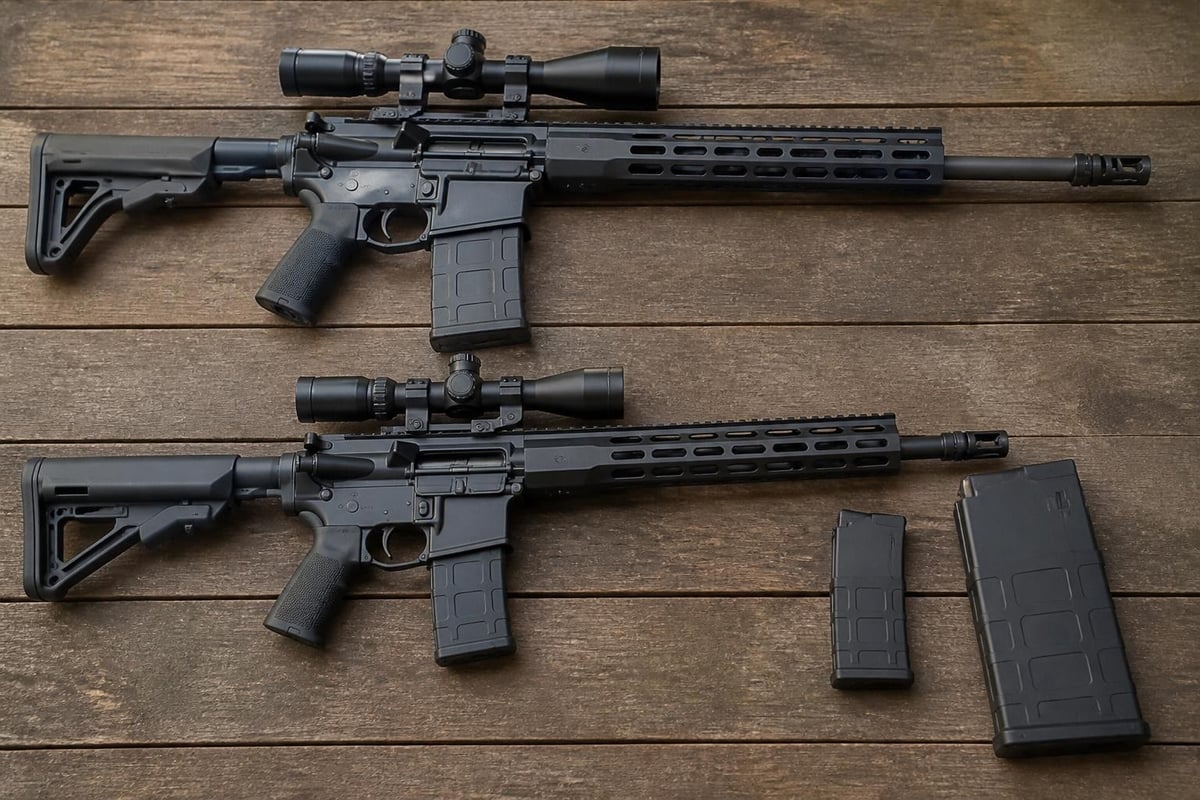
The AR-10's larger cartridge necessitates a scaled-up receiver, bolt carrier group, and barrel. A typical AR-15 weighs between 6-7 pounds unloaded with a 16-inch barrel. The equivalent AR-10 configuration weighs approximately 8-10 pounds, with some precision models exceeding 11 pounds before optics and accessories.
This weight difference becomes particularly relevant for hunters who cover significant ground on foot or shooters who need to maintain ready positions for extended periods. The additional two to four pounds might seem modest on paper but becomes substantial after several hours afield.
Key Dimensional Differences:
- Receiver length: AR-10 measures approximately 0.75 inches longer
- Receiver width: AR-10 is roughly 0.5 inches wider
- Magazine well: AR-10 accommodates larger .308 magazines
- Buffer tube diameter: Identical external dimensions but different spring rates
Parts Compatibility and Interchangeability
One common misconception among new AR builders concerns parts compatibility between platforms. While the AR-15 vs AR-10 comparison reveals similar appearances, parts interchangeability is limited to specific components.
Compatible Components
Several parts do cross over between platforms, offering some cost savings and standardization benefits:
- Lower parts kits (trigger, safety selector, magazine release, bolt catch)
- Pistol grips
- Buffer tubes (commercial and mil-spec dimensions)
- Stocks (any AR-15 stock fits an AR-10 buffer tube)
- Charging handles (standard and ambidextrous types)
- Handguards and rail systems (platform-specific mounting required)
- Gas blocks (must match barrel journal diameter)
Platform-Specific Parts
Critical components remain entirely incompatible between platforms due to dimensional and strength requirements:
- Upper receivers
- Lower receivers
- Bolt carrier groups
- Barrels
- Magazines
- Barrel nuts and extensions
The critical differences in AR-10 builds stem from the larger cartridge's pressure requirements and dimensional constraints. Additionally, AR-10 parts compatibility faces another challenge: unlike the AR-15's standardized specifications, AR-10 components vary between manufacturers, with DPMS-pattern and Armalite-pattern representing two distinct receiver designs.
Ammunition Cost and Availability Analysis
The practical economics of the AR-15 vs AR-10 comparison significantly impact long-term ownership costs. Ammunition represents one of the largest ongoing expenses for active shooters, making price differences materially important.
Current Market Pricing
As of 2026, bulk .223 Remington and 5.56mm NATO ammunition typically costs $0.35-0.50 per round for standard ball ammunition. Premium defensive or match-grade loads range from $0.75-1.50 per round. In contrast, .308 Winchester ammunition starts around $0.80-1.20 per round for basic FMJ loads, with match and hunting ammunition commanding $1.50-3.00 per round.
For a shooter firing 1,000 rounds annually, the ammunition cost difference between platforms amounts to $450-700 favoring the AR-15. Competitive shooters or those who train regularly will see even larger disparities.
Availability Considerations
The 5.56mm NATO cartridge benefits from enormous commercial and military production capacity. Even during periods of market disruption, .223/5.56mm ammunition remains more readily available than .308 Winchester. However, both calibers enjoy sufficient commercial support that availability rarely becomes prohibitive for either platform.
Hunting Applications and Game Suitability
The AR-15 vs AR-10 decision often hinges on hunting requirements. Each platform excels in different scenarios, with caliber capabilities determining appropriate game species and hunting methods.
AR-15 Hunting Roles
The .223 Remington performs admirably on varmints, predators, and smaller game animals. Coyotes, prairie dogs, groundhogs, and similar-sized animals fall well within the cartridge's capabilities at realistic hunting distances. Some states permit .223 for deer hunting with appropriate bullet selection, though many hunters consider it marginal for this application.
The AR-15's light weight and minimal recoil make it ideal for:
- Varmint hunting requiring rapid follow-up shots
- Predator hunting where quick target acquisition matters
- Youth hunters learning fundamentals
- Extended carry in rough terrain
AR-10 Hunting Advantages
The .308 Winchester's substantially greater energy makes the AR-10 a legitimate big game rifle. Whitetail deer, mule deer, black bear, hogs, and even elk fall within the cartridge's ethical harvest capabilities with proper shot placement and bullet selection.
For hunters seeking premium hunting experiences, partnerships like those offered through programs including The Upland Escape Giveaway demonstrate how different hunting disciplines require purpose-built equipment. While that particular promotion focuses on wingshooting, the principle of matching equipment to game remains universal across all hunting pursuits.
Tactical and Defensive Considerations
The AR-15 vs AR-10 comparison extends beyond hunting into home defense and tactical applications. Each platform offers distinct advantages depending on the specific scenario and user requirements.
Home Defense Evaluation
Most defensive firearms experts recommend the AR-15 for home defense applications. The lighter weight allows easier manipulation in confined spaces, while reduced recoil enables faster follow-up shots. The 5.56mm cartridge also demonstrates less over-penetration risk through interior walls compared to .308 Winchester when using appropriate defensive ammunition.
The AR-10's greater power provides no meaningful advantage in typical defensive scenarios, where engagement distances rarely exceed 25 yards. The additional weight and recoil actually hinder rapid target transitions and accuracy under stress.
Long-Range Precision Applications
The tables turn decisively when engagement distances extend beyond 300 yards. The complete comparison between these platforms shows the AR-10's superior ballistic performance at distance. The heavier .308 bullets resist wind deflection better and maintain energy levels that guarantee reliable terminal performance.
Precision rifle competitors working at 600-1,000 yards typically favor the AR-10 platform. The increased inherent accuracy potential and superior ballistic coefficient of common .308 match bullets provide measurable advantages in competitive environments.
| Application | Recommended Platform | Primary Advantage |
|---|---|---|
| Home Defense | AR-15 | Maneuverability, recoil control |
| Varmint Hunting | AR-15 | Ammunition cost, rapid fire |
| Big Game Hunting | AR-10 | Terminal energy, range |
| 3-Gun Competition | AR-15 | Speed, weight, ammunition capacity |
| Long-Range Precision | AR-10 | Ballistic performance, wind resistance |
Magazine Capacity and Feeding Systems
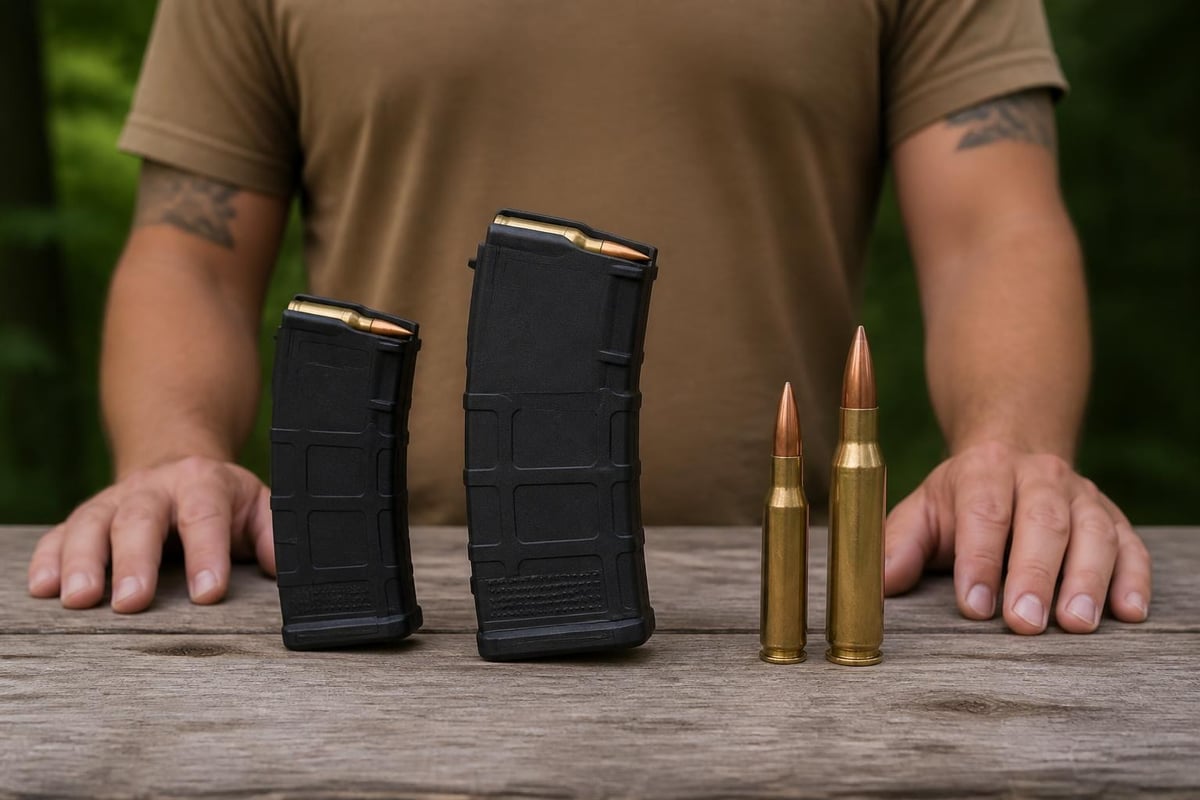
Magazine capacity represents another practical consideration in the AR-15 vs AR-10 evaluation. Standard AR-15 magazines hold 30 rounds of 5.56mm ammunition, with reliable options available in 10, 20, 40, and even 60-round configurations. The smaller cartridge dimensions allow higher capacities without excessive weight or bulk.
AR-10 magazines typically hold 20 rounds as standard capacity, with 10 and 25-round variants available. The larger .308 cartridge dimensions and weight make 30-round AR-10 magazines bulky and heavy enough to affect handling characteristics. A loaded 20-round AR-10 magazine weighs approximately the same as a loaded 30-round AR-15 magazine.
Reliability Considerations
AR-15 magazine technology has matured over decades of military and civilian use. Quality magazines from established manufacturers provide exceptional reliability across diverse conditions. AR-10 magazines face greater challenges due to the heavier cartridges and higher feeding forces involved. Additionally, the lack of standardization among AR-10 manufacturers means magazines designed for DPMS-pattern rifles may not function in Armalite-pattern receivers.
Customization and Aftermarket Support
The modular nature of both platforms allows extensive customization, though aftermarket support varies significantly. The AR-15 enjoys the most robust aftermarket ecosystem of any rifle platform worldwide. Virtually every conceivable upgrade, modification, and accessory exists from multiple manufacturers at various price points.
Available Upgrades and Modifications
AR-15 owners can choose from hundreds of barrel manufacturers, dozens of trigger options, countless handguard designs, and extensive stocks, grips, and furniture variations. This competitive marketplace drives innovation while keeping prices reasonable through competition.
The AR-10 aftermarket, while robust, operates at a smaller scale. Fewer manufacturers produce AR-10-specific components, and compatibility issues between DPMS and Armalite patterns complicate parts selection. Prices tend to run 20-40% higher for equivalent AR-10 components compared to AR-15 parts.
Popular Customization Categories:
- Free-float handguards and rail systems
- Match-grade triggers (single-stage and two-stage)
- Adjustable gas blocks for suppressor use
- Precision barrels in various lengths and profiles
- Enhanced bolt carrier groups
- Ambidextrous controls and charging handles
Practical Accuracy Expectations
Understanding realistic accuracy capabilities helps shooters set appropriate expectations for the AR-15 vs AR-10 comparison. Both platforms can deliver excellent precision with quality components and ammunition, though inherent mechanical differences affect ultimate accuracy potential.
AR-15 Accuracy Standards
A quality AR-15 with match-grade barrel and ammunition should deliver 1-1.5 MOA accuracy from a stable rest. Exceptional builds with premium barrels, carefully tuned gas systems, and match ammunition can achieve sub-MOA performance. The lighter recoiling cartridge allows shooters to better observe bullet impact and spot their own shots through magnified optics.
AR-10 Accuracy Performance
The AR-10 platform faces greater mechanical challenges in achieving ultimate precision. The heavier reciprocating mass, increased recoil impulse, and greater barrel vibration create more variables affecting accuracy. Nevertheless, quality AR-10 builds routinely deliver 1-1.5 MOA accuracy, with precision-focused configurations achieving sub-MOA groups.
The practical accuracy advantage favors the AR-10 at extended ranges, where the .308's superior ballistic coefficient maintains better velocity and energy retention. While both platforms may shoot similar group sizes at 100 yards, the AR-10's performance advantage becomes apparent beyond 400 yards.
Training and Skill Development Factors
The ar-15 vs ar-10 decision impacts training efficiency and skill development, particularly for newer shooters. The lower ammunition costs and reduced recoil of the AR-15 platform facilitate more frequent training sessions and faster skill acquisition.
New shooters can fire more rounds per session without developing flinch or fatigue-induced bad habits. The reduced recoil allows better focus on fundamentals like trigger control, sight alignment, and breathing techniques. Once fundamentals are solid, transitioning to the AR-10's greater recoil becomes manageable.
Experienced shooters appreciate how the AR-10 demands better fundamentals. The increased recoil punishes poor technique more severely, making the platform excellent for advanced shooters seeking to refine their skills. However, this same characteristic makes the AR-10 less forgiving for those still developing basic marksmanship fundamentals.
Maintenance and Durability Comparison
Both platforms share similar maintenance requirements, though the AR-10's higher operating pressures and forces create slightly different wear patterns. Regular cleaning, lubrication, and inspection of critical components ensure reliable function for both rifles.
The AR-15's lighter operating forces generally result in longer component life. Bolt lugs, extractors, and ejectors typically show less wear over equivalent round counts compared to AR-10 parts. However, quality AR-10 components manufactured to appropriate specifications provide excellent durability when properly maintained.
Essential Maintenance Tasks:
- Clean and lubricate bolt carrier group every 500-1,000 rounds
- Inspect gas rings, extractor spring, and ejector spring regularly
- Check barrel extension and chamber for carbon buildup
- Verify gas key staking and carrier key screws remain tight
- Monitor barrel for accuracy degradation (typically after 5,000-10,000 rounds for AR-15, 3,000-5,000 for AR-10)
Cost of Ownership Analysis
Initial purchase price represents only the beginning of ownership costs. The complete AR-15 vs AR-10 financial comparison must account for ammunition, magazines, optics, and accessories appropriate to each platform's typical use case.
Entry-level AR-15 rifles start around $500-700, with quality mid-tier options in the $800-1,200 range. Premium builds and factory rifles extend to $2,000-3,000. The AR-10 market begins around $900-1,100 for basic models, with quality options starting near $1,400-1,800. Premium AR-10 rifles commonly reach $2,500-4,000.
These initial cost differences pale compared to long-term ammunition expenses for active shooters. Over five years of regular shooting, ammunition costs will exceed the rifle's purchase price many times over, making the AR-15's ammunition economy particularly attractive for high-volume shooters.
Choosing between the AR-15 and AR-10 ultimately depends on your specific applications, from varmint hunting and home defense to big game hunting and long-range precision shooting. Both platforms offer exceptional modularity, reliability, and performance within their design parameters. Whether you need the lightweight handling and economical operation of the AR-15 or the extended range and hard-hitting power of the AR-10, RCS Outdoors provides the firearms, ammunition, and expertise to support your shooting pursuits. Explore their extensive selection to find the right platform for your needs.


