

Glock 19 vs SIG P320: A Professional Comparison Guide
The debate between the Glock 19 and SIG P320 represents one of the most discussed comparisons in modern firearms. Both pistols have earned widespread adoption among law enforcement agencies, military units, and civilian shooters. Each platform brings distinct advantages to the table, from Glock's proven simplicity to SIG's innovative modularity. Understanding the nuanced differences between these two industry-leading handguns enables informed decision-making whether you're selecting a duty weapon, concealed carry pistol, or range companion. This comprehensive analysis examines critical factors including ergonomics, reliability, customization potential, and real-world performance.
Platform History and Market Position
The Glock 19 debuted in 1988 as a compact version of the full-size Glock 17, quickly establishing itself as the benchmark for reliability in polymer-framed pistols. Its straightforward design philosophy prioritized function over features, creating a weapon system that performed consistently across extreme conditions.
SIG Sauer introduced the P320 in 2014, bringing a revolutionary modular design to the striker-fired market. The P320 gained significant recognition when the U.S. military selected it as the M17/M18 service pistol in 2017, replacing the long-serving Beretta M9.
Design Philosophy Differences
The glock 19 vs sig p320 comparison reveals fundamentally different approaches to handgun design. Glock maintains a minimalist philosophy where fewer parts translate to fewer potential failure points. The company has refined this design through six generations while preserving the core architecture.
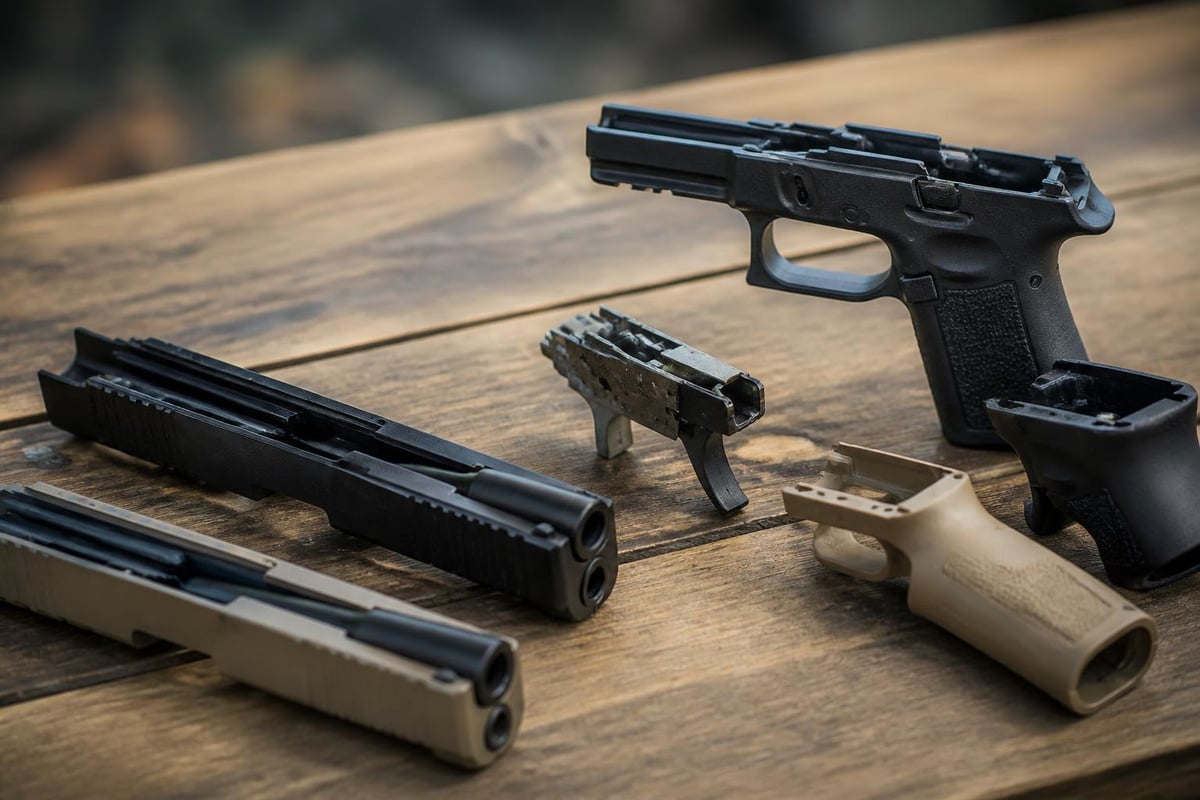
SIG's approach centers on adaptability. The P320's serialized fire control unit allows users to swap grip modules, slides, and barrels without creating a new firearm. This modularity addresses varied mission requirements and hand sizes within a single platform.
Specifications and Dimensions
Understanding the physical characteristics of each platform establishes the foundation for practical comparison. The standard Glock 19 Gen 5 and SIG P320 Compact share similar size categories but differ in critical measurements.
| Specification | Glock 19 Gen 5 | SIG P320 Compact |
|---|---|---|
| Overall Length | 7.36 inches | 7.2 inches |
| Height | 5.04 inches | 5.3 inches |
| Width | 1.26 inches | 1.4 inches |
| Barrel Length | 4.02 inches | 3.9 inches |
| Weight (Empty) | 23.65 oz | 26 oz |
| Magazine Capacity | 15+1 rounds | 15+1 rounds |
The Glock 19 maintains a slimmer profile, which many shooters find advantageous for concealed carry. However, the P320's slightly taller grip accommodates different hand sizes more effectively through interchangeable modules.
Ergonomics and Grip Considerations
Grip angle represents one of the most frequently cited differences in the glock 19 vs sig p320 discussion. The Glock features an 18-degree grip angle that some shooters initially find aggressive, though most adapt quickly. This angle naturally points high for many users, requiring conscious adjustment during presentation.
The P320 employs a more traditional 1911-style grip angle of approximately 20 degrees. Shooters transitioning from other platforms often find this angle more intuitive. The modular grip system offers small, medium, and large sizes, plus various textures and profiles.
Key ergonomic factors:
- Glock's finger grooves (removed in Gen 5) previously limited customization
- P320's flat trigger shoe provides consistent finger placement
- Glock's hump backstrap supports high grip placement
- SIG's undercut trigger guard facilitates higher hand positioning
- Both platforms now offer front cocking serrations for press checks
Trigger Systems and Shooting Performance
The trigger mechanism significantly influences accuracy and shooter confidence. These platforms take distinctly different approaches to striker-fired trigger design, as detailed in comparisons of their trigger characteristics.
Glock Safe Action Trigger
Glock's trigger incorporates three automatic safeties: trigger safety, firing pin safety, and drop safety. The system requires approximately 5.5 pounds of pressure with a relatively short reset of about 0.1 inches.
The trigger pull follows a consistent arc with a somewhat mushy take-up before reaching a less defined wall. The break occurs predictably, though not crisply. This design prioritizes reliability and consistency over refinement.
SIG P320 Flat Trigger
The P320 offers both curved and flat trigger options, with many preferring the flat profile. Factory triggers typically break between 5.5 and 6.5 pounds with a shorter, crisper break than the Glock.
The P320's trigger provides a more defined wall before breaking, delivering feedback that many competitive shooters appreciate. The reset is audible and tactile, measuring approximately 0.15 inches.
Reliability and Durability Analysis
Both platforms have demonstrated exceptional reliability across millions of rounds in diverse conditions. However, their internal construction differs significantly.
The Glock 19 uses polymer for the frame with steel slide rails insert-molded into the frame. Internal components employ a combination of machined steel parts and Metal Injection Molding (MIM) for specific components. This construction has proven remarkably durable through decades of service.
The P320 initially faced scrutiny regarding durability of MIM versus machined parts, particularly the fire control unit components. SIG has addressed early concerns through design refinements and upgraded materials.
Documented reliability factors:
- Glock 19: Proven service life exceeding 100,000 rounds with proper maintenance
- P320: Military testing validated 35,000-round service life for M17/M18
- Both platforms function reliably in temperatures from -40°F to 140°F
- Corrosion resistance favors Glock's nDLC finish over SIG's standard Nitron
- Magazine reliability remains excellent for both manufacturers
Customization and Modularity
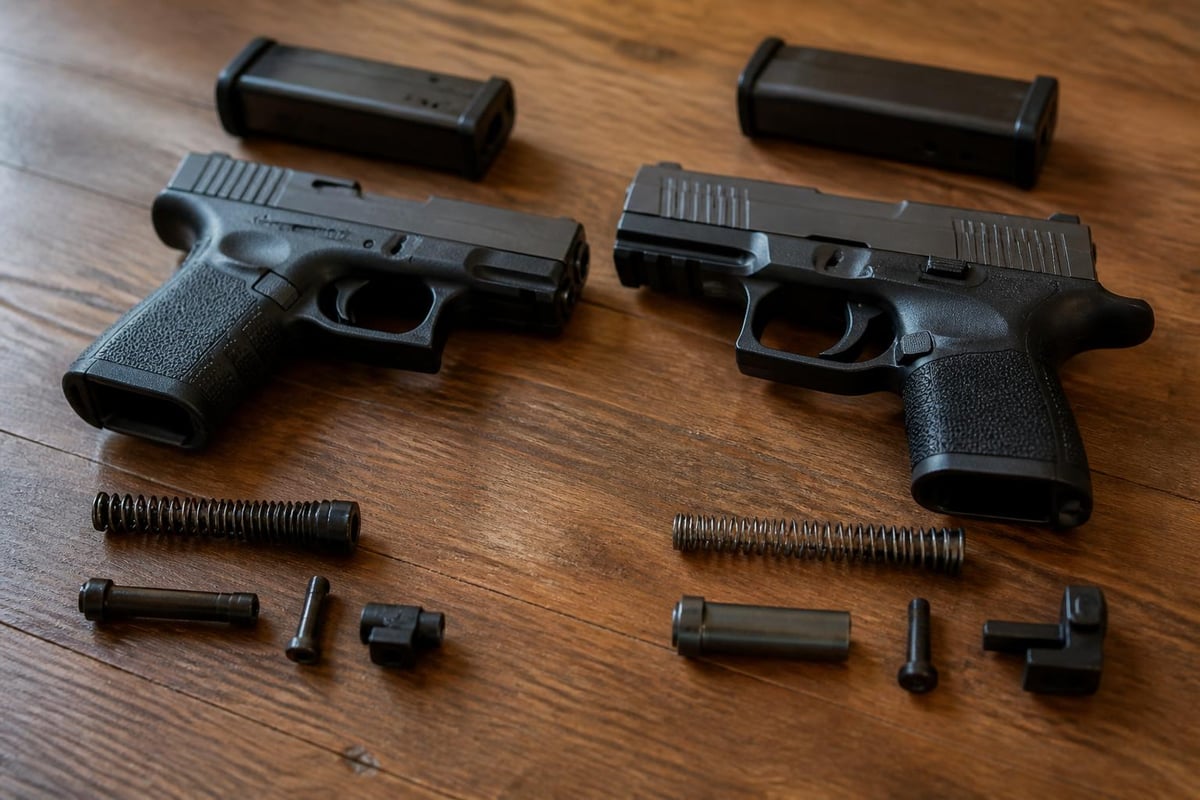
The glock 19 vs sig p320 debate intensifies when examining customization potential and aftermarket support. Both platforms excel in this area but through different mechanisms.
Glock Aftermarket Ecosystem
The Glock platform benefits from the largest aftermarket support in the industry. Shooters can modify virtually every component:
- Triggers from manufacturers like Apex, Overwatch Precision, and Timney
- Barrels offering different lengths, finishes, and threading options
- Slides with various optics cuts, lightening patterns, and finishes
- Internal components including connector, striker, and spring assemblies
- Frame modifications including stippling, undercuts, and grip reductions
The extensive parts availability means competitive shooters can build highly specialized Glock variants. However, each modification requires disassembly and fitting.
SIG Modular Flexibility
The P320's factory modularity represents its primary advantage. Users can transform a compact carry gun into a full-size competition pistol in minutes:
- Remove slide from grip module
- Extract serialized fire control unit
- Install FCU in new grip module
- Install desired slide assembly
- Insert appropriate magazine
This system enables caliber conversions (9mm, .357 SIG, .40 S&W, .45 ACP), size changes (subcompact to full-size), and role adaptations without purchasing additional firearms. The aftermarket has responded with grip modules from Icarus Precision, Wilson Combat, and others.
Optics Mounting and Modern Features
Modern defensive handguns increasingly incorporate optics-ready slides. Both manufacturers have adapted to this trend with varying approaches.
Glock MOS System
Glock's Modular Optic System (MOS) uses adapter plates to accommodate various red dot footprints. The Gen 5 MOS versions feature:
- Forward slide serrations for manipulation
- Improved MOS plate system with better sealing
- Ambidextrous slide stop levers
- Flared magazine well
- Marksman barrel with improved accuracy
The MOS system adds minimal height while maintaining compatibility with most iron sight configurations. However, some precision shooters prefer direct-milled slides from aftermarket providers.
SIG X-Series and Pro Cut Slides
SIG offers factory optics cuts for popular red dot patterns including Romeo1Pro, RMR, and DeltaPoint Pro. The X-Series variants include:
- Flat trigger with reduced pull weight
- Enhanced grip texture patterns
- Deeper slide cuts for faster cycling
- Lightened triggers and smoother pulls
The RXP (Romeo X Pro) models ship with factory-installed SIG Romeo optics, providing a complete solution. This integration eliminates compatibility concerns and co-witness complications.
When selecting firearms and accessories, many shooters appreciate the extensive selection available through retailers like RCS Outdoors, which offers both platforms alongside the components needed to optimize them for specific applications.

Capacity and Ammunition Considerations
Standard magazine capacity matches at 15+1 for comparable models. However, magazine ecosystem and compatibility differ significantly.
Glock magazines benefit from universal compatibility across generations and widespread availability. The 19 accepts:
- Standard 15-round magazines
- Glock 17 17-round magazines with extended base
- Extended 19-round, 24-round, and 33-round options
- Training magazines from multiple manufacturers
- Aftermarket options with enhanced followers and springs
The P320 magazine situation has evolved through several iterations. Early magazines faced reliability concerns that SIG addressed through redesigns. Current magazines offer excellent reliability with:
- 15-round compact magazines
- 17-round and 21-round full-size options
- Flush-fit magazines for different grip modules
- Limited but growing aftermarket support
Both platforms chamber standard 9x19mm ammunition reliably, from 115-grain target loads through 147-grain defensive rounds. Neither exhibits particular ammunition sensitivity.
Safety Mechanisms and Handling
Passive safety systems define both platforms, eliminating manual safeties in standard configurations. This design philosophy prioritizes rapid deployment while maintaining drop safety.
The Glock incorporates three independent safety mechanisms that automatically engage when not firing:
- Trigger safety prevents rearward movement without proper finger placement
- Firing pin safety blocks the striker until trigger fully pressed
- Drop safety prevents firing if dropped from any angle
The P320 employs similar but distinct safety features following the 2017 voluntary upgrade program. SIG redesigned the trigger mechanism to address discharge concerns when dropped at specific angles. Current production includes:
- Enhanced trigger safety with positive engagement
- Improved sear geometry preventing inadvertent release
- Firing pin safety blocking striker travel
- Disconnect safety ensuring single shot per trigger pull
Neither platform requires manual safety manipulation, though both manufacturers offer variants with thumb safeties for specific applications. The consistent trigger pull eliminates the double-action/single-action transition that complicates some designs.
Real-World Performance Metrics
Field performance data from law enforcement agencies and military units provides valuable insight into the glock 19 vs sig p320 comparison. Numerous departments have deployed both platforms with documented results, as explored in recent comparative analyses.
Glock 19 Service Record
Agencies using the Glock 19 report:
- Armorer maintenance averaging 15-20 minutes per firearm annually
- Parts replacement primarily limited to recoil springs and extractors
- Failure rates below 0.1% across service life
- Intuitive operation requiring minimal training transition
The Glock's long service history provides extensive data supporting its reliability claims. Departments rarely experience catastrophic failures outside extreme neglect scenarios.
P320 Adoption Outcomes
Military and law enforcement adoption of the P320 demonstrates:
- Reduced training time due to consistent trigger pull
- Modularity enabling role-specific configurations without inventory expansion
- Improved accuracy scores in qualification testing versus previous platforms
- Lower maintenance costs through fire control unit replacement versus complete firearms
The U.S. military's selection process subjected the P320 to rigorous testing including 12,000-round endurance trials, environmental exposure, and drop testing from multiple orientations.
Cost Analysis and Value Proposition
Price considerations extend beyond initial purchase to include magazines, holsters, replacement parts, and customization components.
| Cost Factor | Glock 19 Gen 5 | SIG P320 Compact |
|---|---|---|
| MSRP | $599-$649 | $599-$679 |
| Street Price | $499-$549 | $529-$599 |
| Factory Magazines | $25-$35 | $35-$45 |
| Aftermarket Mags | $15-$25 | $30-$40 |
| Replacement Parts | Widely available | More limited |
| Holster Options | Extensive | Growing |
The Glock maintains a cost advantage through magazine pricing and aftermarket component availability. However, the P320's modularity potentially reduces long-term costs by eliminating additional firearm purchases for different roles.
Total ownership cost considerations:
- Glock benefits from cheaper magazines and parts
- SIG's caliber conversion kits ($300-$400) cost less than separate firearms
- Training ammunition costs remain identical
- Customization budgets favor Glock's extensive aftermarket
- Resale values remain strong for both platforms
Training and Skill Development
The learning curve associated with each platform influences long-term proficiency. Both pistols accommodate shooters from beginner to expert levels.
The Glock 19's consistent trigger pull and simple manual of arms facilitates rapid skill acquisition. New shooters develop proper fundamentals without compensating for complex controls. The trigger requires disciplined finger placement to avoid premature discharge during high-stress scenarios.
The P320's more refined trigger assists accuracy development by providing clearer feedback during the press. The break occurs at a more defined wall, helping shooters understand proper trigger control. However, the lighter pull weight demands equal discipline regarding finger placement and holstering procedures.
Both platforms reward proper grip technique with controllable recoil and rapid sight recovery. The bore axis height remains comparable, producing similar muzzle flip characteristics. Experienced shooters typically achieve similar split times and accuracy with either pistol after familiarization.
Concealed Carry Considerations
Concealment requirements often drive handgun selection for civilian carriers. The glock 19 vs sig p320 comparison reveals subtle but meaningful differences for everyday carry, as discussed in detailed carry comparisons.
Glock 19 Carry Characteristics
The slimmer profile (1.26 inches) provides advantages for appendix and inside-waistband carry. The lighter weight reduces fatigue during extended wear periods. The aggressive grip texture maintains control but may irritate skin during direct contact.
Popular carry configurations include:
- Appendix inside waistband with minimal printing
- Strong-side hip carry with good concealment under untucked shirts
- Off-body carry in bags and vehicle safes
- Backup weapon for uniformed officers
P320 Compact Concealment
The slightly wider frame (1.4 inches) and additional weight challenge deep concealment but remain manageable for most body types. The modular system enables users to switch between compact and subcompact configurations based on seasonal clothing or specific situations.
The P320's advantages for carry include:
- Grip modules with reduced thickness for better concealment
- Smoother trigger for precise shot placement under stress
- Easy adaptation between roles without purchasing separate firearms
- Superior sights on factory models
Both platforms have spawned dedicated concealed carry variants. The Glock 19 serves as the foundation for countless custom builds, while SIG offers the P320 X-Compact specifically optimized for concealment.
Maintenance and Long-Term Ownership
Routine maintenance requirements remain minimal for both platforms, though procedures and part replacement intervals differ.
Glock Maintenance Protocol
Field stripping requires no tools and takes approximately 10 seconds. Recommended maintenance includes:
- Clean and lubricate every 500 rounds or monthly
- Replace recoil spring assembly every 5,000 rounds
- Inspect extractor and striker assembly every 10,000 rounds
- Replace firing pin spring every 15,000 rounds
Glock's simple design means most shooters can perform all maintenance without professional assistance. Parts availability through multiple distributors ensures minimal downtime.
P320 Maintenance Requirements
The modular design complicates field stripping slightly but enables easier detailed cleaning. Maintenance schedule includes:
- Clean and lubricate every 500 rounds or monthly
- Inspect fire control unit for wear every 2,000 rounds
- Replace recoil spring assembly every 5,000 rounds
- Examine sear and striker components every 10,000 rounds
The serialized fire control unit represents both advantage and limitation. If damaged, the FCU requires factory repair or replacement, though this rarely occurs within normal service life.
Mission-Specific Applications
Different operational requirements favor specific platform characteristics. Understanding these nuances helps match the pistol to its intended role.
Duty/Law Enforcement:
Both platforms excel in this role. The P320's modularity enables departments to standardize training while accommodating different hand sizes. The Glock's proven track record and minimal training requirements maintain its dominant market position.
Competitive Shooting:
Glock benefits from extensive aftermarket support for competition modifications. The P320 X-Five series offers factory competition features including adjustable sights, extended controls, and enhanced triggers. USPSA and IDPA competitors achieve top finishes with both platforms.
Home Defense:
Either pistol provides reliable home defense capabilities. The Glock's simplicity under stress and common magazine compatibility with carbines offer advantages. The P320's superior factory sights and trigger assist accurate shot placement in low-light conditions.
Concealed Carry:
The Glock 19's slimmer profile provides marginal concealment advantages. The P320's modularity enables seasonal adaptation between compact and subcompact configurations. Personal preference and body type ultimately determine which conceals more effectively.
Ammunition Performance and Accuracy
Both platforms deliver excellent accuracy with quality ammunition. Factory barrels typically achieve 2-3 inch groups at 25 yards from a rest with premium defensive loads.
The Glock 19 Gen 5 includes an improved Marksman barrel featuring enhanced polygonal rifling. This design stabilizes projectiles more consistently, reducing group sizes compared to earlier generations. The barrel's 1:10 twist rate handles bullet weights from 115 to 147 grains effectively.
The P320 employs conventional rifling in most configurations, with some X-Series models featuring match-grade barrels. The standard barrel performs admirably with all common bullet weights and profiles. Aftermarket barrel options from manufacturers like True Precision and KKM provide additional accuracy potential.
Neither platform exhibits particular ammunition sensitivity. Both function reliably with:
- Full metal jacket training ammunition
- Jacketed hollow points for defensive use
- +P and +P+ pressure loadings
- Subsonic ammunition for suppressed applications
- Steel-cased imported training rounds
Accuracy differences between the platforms remain negligible for practical applications. Skilled shooters achieve similar results once familiarized with each trigger system.
Holster Compatibility and Accessories
The mature Glock ecosystem provides unmatched holster selection spanning every carry method and retention level. Manufacturers produce options for:
- Inside waistband concealment in leather, Kydex, and hybrid materials
- Outside waistband duty holsters with active retention
- Competition rigs from DAA, Ghost, and Safariland
- Appendix-specific designs optimizing comfort and concealment
- Light-bearing configurations for weapon-mounted illumination
The P320's growing popularity has expanded holster availability significantly. Major manufacturers now offer comprehensive P320 lines, though selection remains smaller than Glock's. The modular system complicates compatibility since grip module size affects holster fit.
Other accessories including weapon lights, lasers, and magazine carriers exist in abundance for both platforms. Streamlight and SureFire dominate the weapon light market with models specifically designed for each pistol. For those building comprehensive firearms collections, browsing the full catalog at RCS Outdoors reveals the extensive accessory ecosystem supporting both platforms.
Selecting between the Glock 19 and SIG P320 ultimately depends on individual priorities regarding modularity, trigger characteristics, and ergonomics. Both platforms deliver proven reliability and performance across defensive, duty, and competitive applications. Whether you value Glock's simplicity and extensive aftermarket or SIG's modularity and refined trigger, RCS Outdoors provides access to both platforms along with the ammunition, accessories, and expertise needed to optimize your chosen system for its intended mission.


